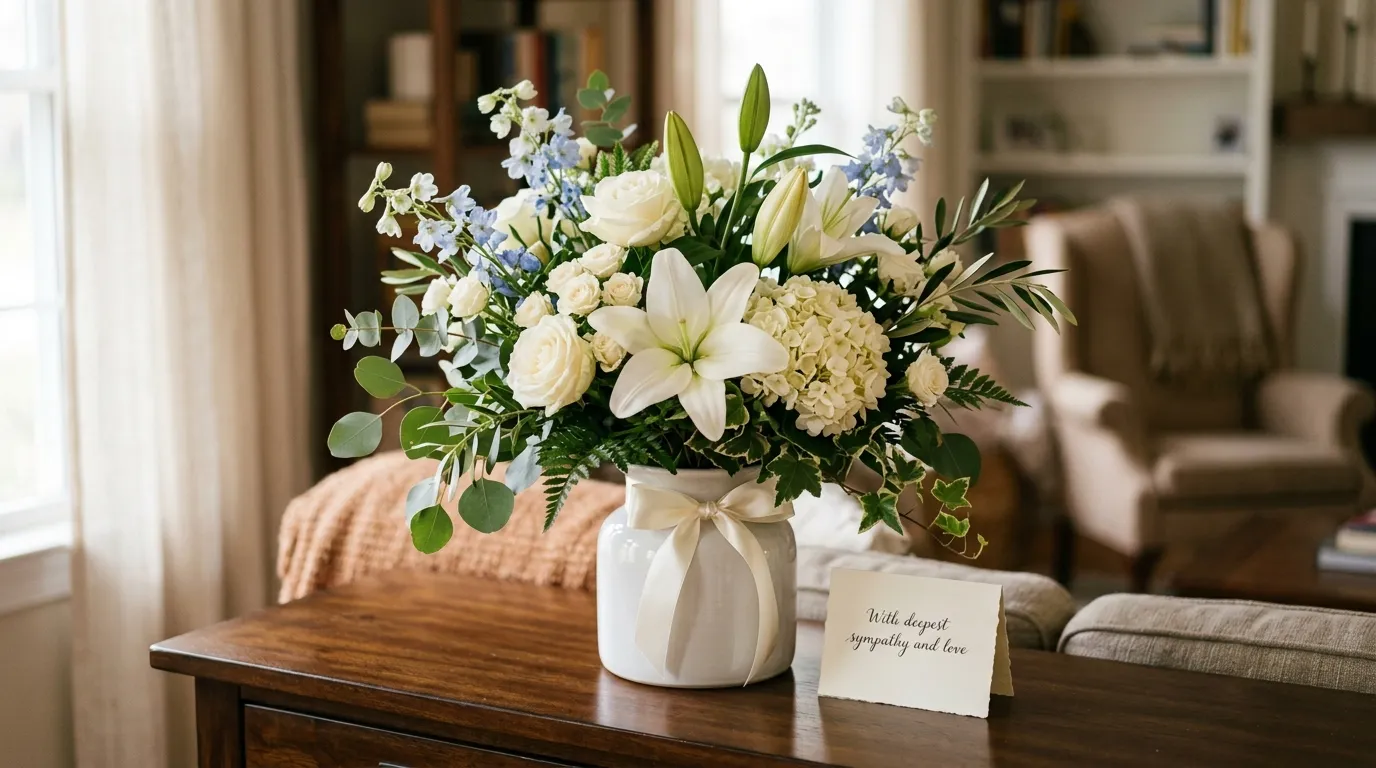
Sending flowers when someone has lost a loved one is one of the kindest, and most universal, ways of showing you care — but it's also one of the moments people feel least sure about getting right. Over the years I've had this conversation hundreds of times in the shop, so here's the guidance I actually give people, without any of the stiffness you sometimes find in etiquette guides.
The Quick Answer
- A wreath (circular) or a spray (one-sided, for the coffin) is usually sent by close family. A bouquet or posy suits friends, colleagues and wider family.
- Check the funeral notice first. If the family has asked for donations instead, a small posy sent to their home is a kind alternative.
- Flowers for the service go to the funeral director. Flowers for the family go to their home.
- Keep the card short and sincere, and sign it clearly so the family knows who it's from.
- It's never too late. A bouquet a week or two after the funeral, when visitors have quietened down, is often especially appreciated.
Wreath, Spray, or Bouquet — What's the Difference?
These three are the ones people most often mix up, and there's no need to overthink it:
- A wreath is circular, traditionally symbolising eternal life, and is most often sent by close family — though it's increasingly used more broadly too. It sits well on the coffin or beside it at the crematorium or graveside.
- A spray is a more structured, one-sided arrangement, usually in a teardrop or fan shape, designed to sit flat on top of the coffin or lean against something at the service. This is a common choice from close family.
- A bouquet or posy tends to be sent by friends, colleagues, or wider family, and is less formal — it can be handed to the family directly, sent to the house, or, especially for smaller funerals, left at the service.
If you're genuinely unsure which is expected, it's completely fine to call the funeral director or the family and simply ask what they'd find helpful — nobody will think it's an odd question.
Check the Family's Wishes First
Many families now ask for donations to a charity "in lieu of flowers," and it's worth checking the order of service, obituary or funeral notice before ordering, as this is usually stated clearly. If donations are requested but you'd still like to send something small and personal, a modest posy addressed to the family at home (rather than the funeral itself) is a lovely, low-key alternative.
What Different Flowers Traditionally Mean
You certainly don't need to know flower symbolism to send something appropriate, but a few meanings come up often enough that it's nice to know them:
- White lilies — the most traditional funeral flower, associated with peace and the restored innocence of the soul.
- Red roses — love and respect, more often sent by immediate family or a partner.
- White roses — reverence, and a gentler alternative to red for wider family or friends.
- Chrysanthemums — in the UK associated with sympathy and grief, though it's worth knowing they carry a more celebratory meaning in some other cultures, so it's worth checking if the family has a specific cultural background.
- Rosemary — remembrance, often included as a foliage note within an arrangement rather than as a standalone flower.
None of this is a strict rulebook — plenty of families simply ask for "her favourite flowers," which is always a lovely, personal alternative to any of the above.
What to Write on the Card
Keep it simple and sincere rather than trying to find a perfect phrase. Something like "With deepest sympathy," "Thinking of you all at this difficult time," or, if you knew them personally, a short specific memory works beautifully — "So grateful for [name]'s kindness over the years" says more than a generic verse ever could. Sign it clearly with your name (and how you knew them, if the family might not immediately place you), so they know who to thank later.
A few examples people often find helpful, depending on how well you knew them:
- Close family: "Forever in our hearts, with all our love" or "Always loved, never forgotten."
- A friend: "With love and fond memories of a wonderful friend" or "Thinking of you all, with so much love."
- A neighbour: "With deepest sympathy from all your neighbours on [street]" or "We'll miss seeing [name] every day. Thinking of you."
- A colleague or workplace: "With sincere condolences from everyone at [company]" or "In fond memory of a much-valued colleague."
Timing — When to Send
Funeral flowers are usually ordered to arrive at the funeral director's or venue in time for the service itself, so it's worth ordering as early as you can once you know the date — a few days' notice gives us time to make something beautiful by hand rather than rushing. If you'd rather send something for afterwards, a bouquet delivered to the family's home a week or two later, when visitors have quietened down, can be an equally thoughtful gesture.
It's Always Alright to Ask
Whatever the situation, whether it's your first time arranging funeral flowers or your tenth, we're always happy to talk it through on the phone — what's appropriate, what the family has asked for, and what will fit the service. There's no such thing as a silly question when it comes to getting this right.
Common Questions
Can I send flowers if the family has asked for donations instead?
Yes, but it's kinder to send them to the family's home rather than the funeral. A modest posy or bouquet delivered to the house is a personal gesture that sits alongside the family's wishes rather than against them.
Where should funeral flowers be delivered?
Flowers for the service usually go to the funeral director, who takes them to the church, crematorium or graveside. Flowers for the family are sent to their home, either before the funeral or in the weeks after.
What should I write on a funeral flower card?
Keep it short and sincere. "With deepest sympathy" or "Thinking of you all at this difficult time" are always appropriate, and a short personal memory means a lot if you knew the person. Sign it clearly so the family knows who it's from.
What colour flowers are appropriate for a funeral?
White and soft pastel flowers are the traditional choice, but there's no strict rule. Many families now ask for bright colours or the person's favourite flowers, and that's always the right thing to follow if it's been requested.
Is it too late to send flowers after the funeral?
Not at all. A bouquet delivered to the family a week or two after the funeral, when visitors have quietened down, is often especially appreciated.
We handle funeral flowers for families across Denby Dale, Huddersfield and Barnsley with care and sensitivity, working closely with local funeral directors.
See Our Funeral Flowers