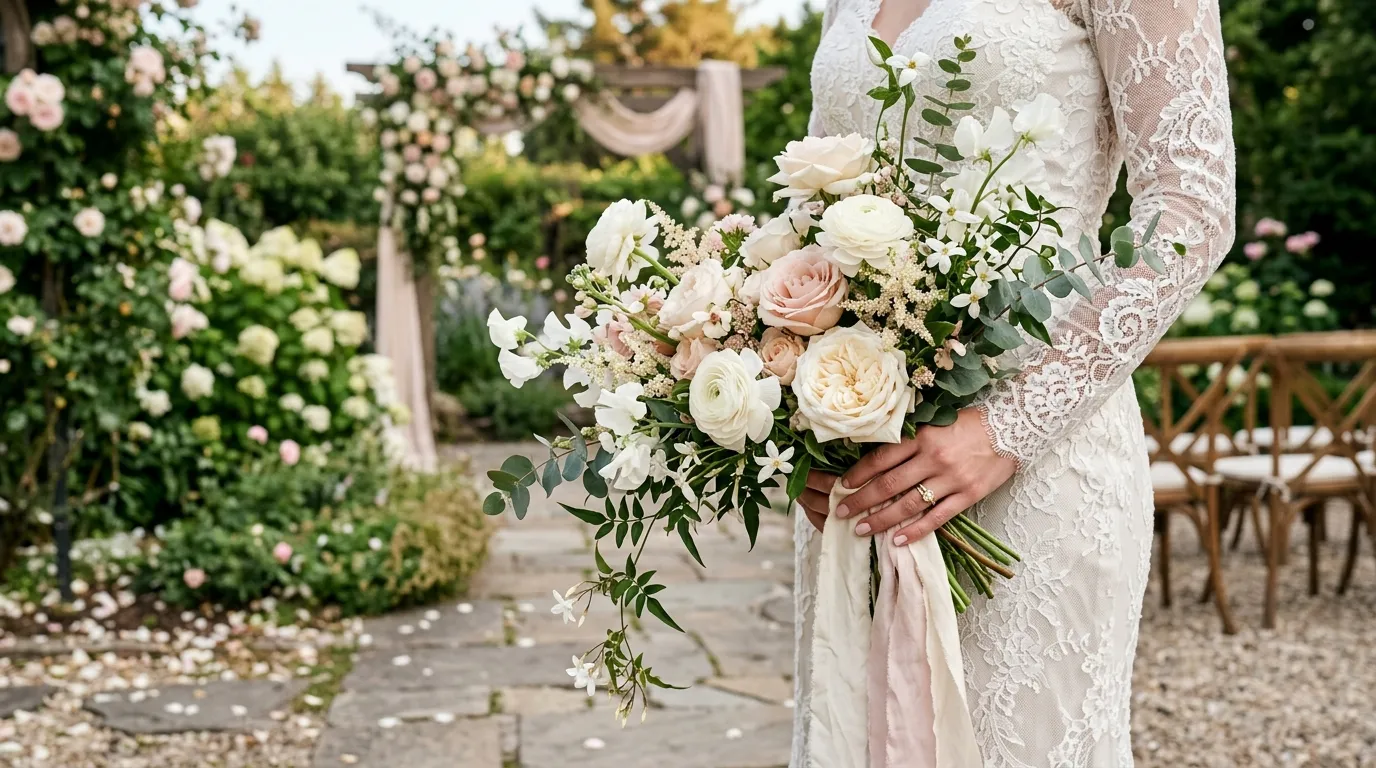
One of the first questions I ask every couple who come in to talk about their wedding flowers is simply: when's the big day? Not because I need it for the diary (though I do), but because the date does most of the work in narrowing down what your flowers could look like. Fighting the season — insisting on peonies in November, say — usually means paying more for flown-in stock that never looks quite as good as what's naturally in season. Working with the season instead almost always gives you a more beautiful, and more affordable, result.
The Quick Answer
- Spring (March–May): tulips, ranunculus, anemones and sweet peas, in blush, cream, lilac and fresh green.
- Summer (June–August): the widest choice, from garden roses and peonies (early summer) to dahlias and delphiniums.
- Autumn (September–November): dahlias, chrysanthemums and amaranthus, in rust, burgundy, mustard and burnt orange.
- Winter (December–February): amaryllis, ranunculus, anemones, hellebores and roses, with evergreens and berries.
Choosing flowers that are in season for your date gives fresher, better-value results. Book your florist six to twelve months ahead, especially for spring and summer dates.
Spring Weddings (March–May)
Spring is a gift for wedding flowers — tulips, ranunculus, anemones, sweet peas and the first of the English garden roses all come into their own, alongside soft green foliage like eucalyptus and jasmine vine. Colour palettes tend to lean towards blush pink, cream, lilac and fresh green, though bold spring bulbs like tulips also do beautifully in stronger colours if you want something more vibrant. Spring is a lovely season for a slightly looser, more "just-picked" bouquet style.
Summer Weddings (June–August)
Summer is peak season for a reason — this is when the widest range of British-grown flowers is available, from garden roses and peonies (early summer especially) to dahlias, delphiniums, cornflowers and scabious later on. It's the easiest season to go big and lush with your arrangements, and the best time of year for a genuinely local, British-grown wedding flower palette if that matters to you. Almost any colour palette works in summer, since there's so much choice.
Autumn Weddings (September–November)
Autumn brings a real shift in mood — dahlias continue into early autumn, joined by chrysanthemums, amaranthus, and rich, textural foliage like copper beech and rosehips. This is the season for warm, earthy palettes: burnt orange, deep burgundy, rust, mustard and chocolate-brown tones all sit beautifully together, alongside plenty of dried and textural elements like wheat or seed heads if you want a more rustic feel.
Winter Weddings (December–February)
Winter weddings lean on a smaller but striking palette — amaryllis, ranunculus, anemones, hellebores and, of course, roses, paired with evergreen foliage, pine, eucalyptus and berries for texture. White, deep red, burgundy and forest green are classic winter combinations, though a "winter white" palette of ivory and silvery-grey foliage is just as popular for a more romantic, wintry look. Winter is also when we lean most on hardy garden roses and hothouse-grown flowers, since so little is naturally outdoors at this time of year in Yorkshire.
What If I Have My Heart Set on an Out-of-Season Flower?
It's not impossible — many popular wedding flowers, including roses and some varieties of lily, are available to some degree all year round through wholesalers, just at a higher price and sometimes with less choice of variety. If there's one flower you can't imagine your day without, tell me early and we'll find a way to include it, even if it means building the rest of the bouquet around it more economically using what's genuinely in season.
A Few Colour Palette Tips
- Bring a fabric swatch of your bridesmaids' dresses or a photo of your venue when we meet — it's far more useful than a colour name, since "blush" means something different to everyone.
- Pick two or three core colours and let the season decide the exact shades and varieties within them, rather than the other way round.
- If you're getting married somewhere with a strong colour of its own — a stone barn, a bright green marquee lining — plan your flowers to complement it rather than compete with it.
Whatever the season, the best wedding flowers are the ones that feel true to the time of year and the couple, rather than forced to match a Pinterest board photographed in a different climate entirely. Bring me your date, your colours, and your venue, and I'll do the rest.
Common Questions
How far in advance should I book my wedding florist?
We recommend six to twelve months ahead, especially for popular spring and summer dates. We'll always do our best with shorter notice too.
How can I keep wedding flower costs down?
Choose flowers that are in season for your date. In-season flowers are fresher, better value and easier to get in quantity, while out-of-season flowers are flown in at a higher price with less choice of variety.
Are peonies available all year round?
Peonies are at their best in late spring and early summer. Outside that window they can sometimes be sourced, but at a much higher price and with limited choice, so garden roses or ranunculus are often a better alternative.
What flowers are in season for a winter wedding?
Amaryllis, ranunculus, anemones, hellebores and roses, paired with evergreen foliage, pine, eucalyptus and berries. Classic winter palettes include white with deep red, or ivory with silvery-grey foliage.
Getting married in Denby Dale, Huddersfield or Barnsley? We'd love to talk through your wedding flowers, from a single bridal bouquet to a full package.
See Our Wedding Flowers